-
Add to CMSIS Solution
packs:- pack: ARM::CMSIS-RTX@5.9.1
Add with cpackget
> cpackget add ARM::CMSIS-RTX@5.9.1
Download
ARM.CMSIS-RTX.5.9.1.packRepository
CMSIS-RTXOverview
Keil RTX version 5 (RTX5) is a real-time operating system (RTOS) for Arm Cortex-M and Cortex-A processor-based devices that implements the CMSIS-RTOS2 API as its native interface.
Modern microcontroller applications must often serve several concurrent activities. Keil RTX5 manages the switching between the activities. Each activity gets a separate thread which executes a specific task and to simplify the program structure. Keil RTX5 is scalable, and more threads can easily be added later. Threads have a priority allowing faster execution of time-critical parts of a user application.
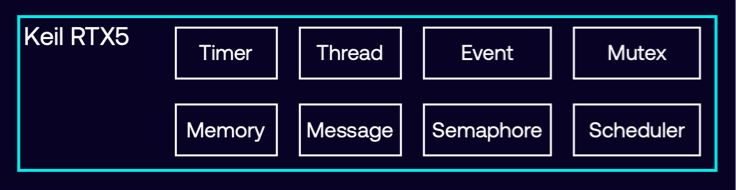
Keil RTX5 offers services needed in many real-time applications, such as threads, timers, memory and object management, and message exchange. The following image shows the services of Keil RTX5.
Features
Open-source
- Full-featured, free-to-use commercial-grade RTOS.
- Shipped under the permissive Apache 2.0 license.
- Configurable with no restrictions.
- Publicly developed on GitHub with full source code available.
Easy to use
- Reduced learning curve leading to faster product development.
- Provides configuration parameters for the kernel operation and the RTX objects.
- Configuration wizard annotations make parameter settings clear and intuitive in IDEs.
Safe and secure
- Keil RTX5 is PSA certified, integrating with the Platform Security Architecture API.
- The safety-certified variant FuSa RTX RTOS is available as part of the Arm Run-Time System for Functional Safety (FuSa RTS)
Flexible scheduling
Keil RTX5 offers various kernel scheduling options, allowing you to choose the best scheduling for your application.
Pre-emptive
- Each thread has a different priority and runs until a higher priority thread is ready to run.
- Commonly used in interactive systems where a device can be in standby or background mode until some input is sent to it.
Round-robin
- Each thread runs for a fixed period of CPU run-time (time slice).
- Data loggers or system monitors typically employ round-robin scheduling to sample all sensors or data-sources in turn with no prioritization.
Co-operative
Each thread runs until it is told to pass control to another thread or reaches a blocking OS call. Co-operative multi-tasking can be seen in applications that require a fixed order of execution.
Fully deterministic behavior
- Known behavior for time critical tasks.
- Events and interrupts are handled within a predefined time (deadline). Applications can rely on consistent and known process timings.
Low-power mode
- Tick-less operation mode for low-power devices.
Designed for embedded systems
- Requires minimal MCU resources with a memory footprint as small as 5 KB (ROM).
- Written for applications running on Arm Cortex-M-based MCUs.
- Quick run time.
Links